Showing posts with label Land Art. Show all posts

31 January 2024

Scans


"It seems to me that the modern painter cannot express this age, the airplane, the atom bomb, the radio, in the old forms of the Renaissance
or of any other past culture. Each age find its own technique."   
                                                                                                                                                   Jackson Pollock        


Art has seen as much experimentation in the last 150 years as the previous 1500 years. This accelerated rate of change occurred in a period of increased scientific knowledge of nature and parallel social developments. The style of figurative realism that emerged in the Renaissance was challenged by the rebellious era of modern art that started at the Salon des Refusés exhibition in Paris in 1863. During the 20th century three methods of image making: photograms, holography and flat-bed scanners, provide insights into the values of modern art. Although recording images without a camera lens, they all share a similarity to photography. As well as recording objects, they subtly transform their appearance, in different ways that are unique to each method.
Photogram by Man Ray
published in Painting 
Photography Film 
(page 77)

Photograms are cameraless photographs created by placing objects directly onto a light-sensitive surface, usually photographic paper, and exposing the composition to light. Unless reversed by copying, photograms are negatives where exposure to light creates darkness. Because a camera lens is not used, images of objects placed on the film or photographic paper are recorded same size. Photograms are as uncanny as images on a pre-digital radar scope, with potentially recognisable white silhouettes emerging from a dark ground. Photograms are the opposite of picturesque. The brooding darkness of their backgrounds suggests a form of 'technological sublime' (1) that is even more explicit in x-ray pictures.

​Photograms have an ambiguous relationship to the cannon of 'serious' photography as they were often used as an introductory exercise for those learning chemistry-based photography. They were the photographic equivalent of learning scales on a piano, with visible tones instead of musical notes, but they also became associated with modern art. Whereas cameras have been designed to imitate the type of perspective associated with Renaissance painting, the distinctive effects made by photograms aligned with the modernist principle of being "truthful to materials" and the older adage "form follows function".

Anyone who has seen an Anglepoise lamp has experienced these ideas made solid. The car designer George Carwardine invented the iconic desk lamp after researching car suspension systems, creating a functional task lamp that was also attractive in the terms of the Bauhaus-inspired ‘machine aesthetic'. Just as the Anglepoise lamp has a stark beauty arising from the expression of mechanical levers and springs, so a photogram is a rather severe image created by the ability of a photographic emulsion to record the beguiling effects of light passing through translucent objects and around the edges of solids but without the more traditionally pleasing effects of chiaroscuro associated with photographs made with a lens. Objects registered as white shadows are uncanny.

​László Moholy-Nagy included photograms made by himself, and the American photographer Man Ray, in his influential book Painting Photography Film published in 1925 (2) in which he postulated an aesthetic and philosophical revolution called "The New Vision" that would unleash the creative potential of society. He described photograms as "light composition, in which light must be sovereignly handled as a new creative means, like colour in paintings and sound in music." Light could create "a new kinetic space-time rendering". (3) Moholy-Nagy derided the "Ruskin-Morris circle" who he accused of ignoring the need to harness machine production to meet the 'biological' needs of society. The New Vision was to be based on technology.

Solar eclipse on 29th May 1919 
photographed by Arthur Eddington
The observed deflection of 
starlight by gravity confirmed 
Einstein's theory of relativity 
and was reported enthusiastically 
worldwide.
Moholy-Nagy speculated that novel optical systems such as prismatic lenses and cameras able to view objects from multiple positions could surpass cubist painting, but new forms of sculpture would acknowledge Einstein's theory of relativity. Whereas the pictures of Futurism showed a superimposition of the object in a sequence of linear movement and Cubism rendered the object as if it were rotated in space, Moholy-Nagy wanted to 'paint' with "flowing, oscillating, prismatic light, in lieu of pigments" to "allow us a better approach to the new conception of space-time." (4) He made light/kinetic sculptures for the 1936 film Things to Come, although they were eventually not included in the finished production.

A complete 'phase transition' of society suggested by the concept of The New Vision (5) never happened, but in 1949 a photographic process capable of exploring Moholy-Nagy's fascination with space/time was proposed. The physicist and engineer Dennis Gabor calculated that combining light reflected from an object with light sent directly to a photographic emulsion would create interference patterns from which a fully three-dimensional image, a hologram, could be reconstructed.

Older methods of stereoscopic photography
Moholy-Nagy would have been fascinated
by holography. In The New Vision - 
Abstract of an Artist he wrote about 
neoplasticism and how constructivist artists 
had sprayed very thin, iridescent layers of
paint on polished surfaces, metals and
synthetic materials "..to which the reflecting
layer underneath gives an ethereal fluctuating
appearance..,.The surface becomes a part of
the atmosphere, of the atmospheric background;
it sucks up light phenomena produced outside
itself...." (Page 39) His description sounds rather
like the experience of viewing a hologram.

create the impression of depth but lack a sense of the roundness of objects. Confusingly, both stereoscopy and holography are often referred to as "3D" pictures. For holography to work it is necessary to use light of a single wavelength which was not fully available until the invention of the laser.​ After the first laser-based hologram was made in 1964 the medium's status as an art form was questioned. The invention of photography between 1825 and 1850 was followed by a similar period of speculation as to whether it could be considered art. For critics in the 20th century the issue of photography was resolved by modernism which valued characteristics that are unique to specific media. For painting, the qualities of flatness and colour were regarded as essential modernist qualities. Paradoxically, the mechanical aspects of photography (as opposed to eye/hand skills) that caused art critics to doubt that it was an art form in the 19th Century allowed the medium to claim a special position within modernism.

​Surrealism and abstraction were important developments in modernism but the ability of photography to record images outside human imagination was equally significant. Both the blurring of objects caused by motion in long exposures and the ultra-sharpness of high-speed photography exceed human perception. Similarly, holography initially only seemed to be a kind of photographic sculpture, but at the University of Nottingham the 1970s Margaret Benyon undertook a fellowship in fine art in the mechanical engineering department where she was able to establish a holography studio and explore a unique feature of the medium.

Margaret Benyon's 'hot air' hologram.
Column of rising air appears dark and
flat among rounded objects.

To make a successful hologram, the photographic emulsion must receive light directly from a laser as well as light reflected from the objects being recorded. As the interference pattern created in the emulsion is a very precise record of the interaction of the wavefront from the laser and the wavefront modified by the shapes of objects, nothing in the arrangement should move by more than a fraction of the wavelength of the light in use. Benyon discovered that movement as slight as the drying of bread would cause a loaf to appear as a flat, dark silhouette. Experiments confirmed that holograms can register time as well as three dimensions in a single image, as Moholy-Nagy desired half a century earlier. Benyon's most intriguing images recorded the movement of hot air from a cup as flat, dark plumes. Time compresses three dimensions into two. (6)

Holography made little impact on the art world, either in the exclusive collectors' art market or the more socially orientated public art sector. Perhaps the exploitation of the ability to register tiny movements of objects as 'non-holograms' was one of the last throws of the dice for modernism. Many of the creative techniques of modernist photography can be thought of as qualified failures in that they are departures from the norms of Renaissance art. Blurring caused by motion, depth of field rendering backgrounds out of focus, the compression of perspective by telephoto lenses and the near spherical perspective of fish-eye lenses are all photographic tropes that make a virtue out of the unconventional. Depiction of movement as a black silhouette in an otherwise three- dimensional field is a uniquely holographic, and modernist, characteristic.

The set up for Margaret Benyon's hot air hologram.

The expectation that artists should use characteristics that are unique to the nature of a particular medium, creating artwork that is as much an expression of its physical properties as any subject, has not spread to popular culture. From the earliest days of cinema, painted backdrops were a common feature of filmed illusions. A current trend is towards the increasing use of computer-generated images in films. Additionally, postmodernism has produced an 'anything goes' culture which influences all media. For artists there is the challenge of deciding what not to include or generate, so great are the possibilities afforded by digital technology.

​Flatbed scanners are associated with digital editing of images and postmodern expectations. For anyone wanting to scan a photograph the software that enables the scanner to operate with a computer presents a preview image and offers the user an opportunity to adjust brightness, contrast and colour before the subsequent image is created. Further digital manipulation can contribute to the elision between photography and illustration, where any departure from visual accuracy is accepted if it is made with sincere and obvious intention. Maps and pictures made for manuals or textbooks are expected to dispense with surplus detail for the sake of clarity. Similarly, the routine surveillance of the Earth by satellites is increasingly undertaken by thematic mapping projects that concentrate of specific geophysical information such as ice-cover or vegetation types. The Earth rotates under them as they orbit from pole to pole, rather like the action of a flatbed scanner.

​Scanners use LEDs for illumination combined with multiple detectors arranged together on a single moving bar that sweeps the underside of a glass platen on which documents or objects can be placed. Scanners were not designed to record objects, so their traveling perspective produces distortions caused by parallel projections in the resultant image. Depth of field is about one centimetre and unreflected light creates dark backgrounds. The darkness is similar to 'flash falloff' seen in photographs taken by the light of an electronic flashgun. Photograms, holography and scanners record distance as darkness because they project light in a dynamic way without relying on ambient illumination.

​Unlike human vision, the photogram process, holograms and scanners bombard their subjects with photons. The phrase "suffocating darkness" is revealing because light feels like it belongs to the air that we breathe. Looking up at a blue sky, there is no apparent difference between atmosphere and light. When a cloud uncovers the sun, light enters a room like fine dust falling from the air. The disparity between the searchlight of technology and how we see, influences how our attention to nature becomes divided between science and art. 1970s Land Art (originally called Earth Art) came close to reconciling this difference.

Land Art projects, mostly in remote areas of the United States, were 
Double Negative was excavated by Michael
Heizer in 1969. 240,000 tons of rock was
bulldozed from two sides of a valley wall.
The sculpture is a void that demonstrates
the imposition of geometry on the
landscape,
and by implication, the whole
of nature.
created in the 1960s and 1970s. The Earth artists individually embarked on a series of diverse sculptural projects, on the scale of civil engineering, using the material of the landscape itself. One of Robert Smithson's early works exhibited mirrors, rock, gravel and sand in an art gallery. The materials were removed from a distant site where mirrors had also been placed and photographed. The methodology resembled a museum exhibit that had resulted from geology fieldwork. Walter De Maria's Lightning Field (1977) almost functions as a science experiment. At a high-altitude site in New Mexico in the United States, De Maria created a one kilometre by one mile array of polished metal poles placed vertically in the ground 67 metres apart. Lightning is said to "sense" the poles when it is within 61 metres of them. (7)

​Land Art seems to have signified an end to the development of landscape art, but it is possible to consider a return of nature to a central position in contemporary art. Imagine a Venn diagram with nature in art at the centre, surrounded by four circles. Firstly, nature that is revealed by science. Secondly, the tradition of landscape art that represents nature as beautiful, sublime or picturesque. Thirdly, climate change, a new mass extinction period and the expansion of the technosphere (the built environment, mining spoil, farming, solar power collectors etc). Fourthly, ambitious plans such as altering plant genomes to enable them to use more atmospheric carbon dioxide, producing 'meat' protein in bioreactors and the duplication of the energy of the sun in thermonuclear power stations. 


(1) Strip mining (2) Contour ploughing (3) The Palm Jumeirah, Dubai - 5.6 square kilometre land reclamation development. 

The expansion of human activity to encompass the majority of the Earth has supported a massive increase in population. This means that there is no simple way back to a pre-industrial world that existed before the 
Anthropocene. Behind the concept of 'sustainability' lie complicated choices around the degree of artificial management of biological and Earth systems. 


​​The Anthropocene epoch is so called because humans are now a geological force. We cause global climate change, move more material than river erosion, control three quarters of land not under ice and are also influencing the course of evolution. The image of a self-consistent nature depicted in traditional landscape art is not true in the Anthropocene. Some of the Land Art projects of the last century presaged this new situation. A new direction for art as metaphor for the complicated and problematic interface between nature and technology in the 21st century is available. Rather than attempting to create visual equivalents to the complexity of all environmental issues art could be a sensitised surface that provides opportunities for contemplation of artificiality itself.
Wooded Landscape with Figures Walking by a Sandy Bank. 
This painting by Jan Wijnants (active 1643 - 1684)  shows 
the remains of an original coastline resulting from the 
reclamation of land from the sea in Holland. This 
picturesque depiction of one aspect of the technosphere 
may appear to be anachronistic, but the type of cultivated 
landscape familiar from landscape painting is equally 
artificial.


(1) Nye, David E. American Technological Sublime. Cambridge, Mass.: MIT Press, 1994.

(2) (3) (4) Moholy-Nagy, László, Hans Maria. Wingler, and Janet. Seligman. Painting, Photography, Film. London: Lund Humphries, 1967.

(5) Moholy-Nagy, László The New Vision ; and, Abstract of an Artist. New York: Wittenborn, 1947.

(6) Benthall, Jonathan. Science and Technology in Art Today. London: Thames and Hudson, 1972.

(7) Kastner, Jeffrey., and Brian. Wallis. Land and Environmental Art : Themes and Movements. London: Phaidon, 1998.Page 109.


03 October 2022

Art Beyond Nature


https://www.blurb.co.uk/b/11259594-art-beyond-nature


From 1826 when the first photograph was made to 1889 when
rolls of celluloid film became available, photography changed
from a medium that required almost as much work to make
one exposure as the creation of a small painting, to a small
portable box that could take multiple pictures, each taking
a fraction of a second to record. The task of attempting to
represent nature 
in a single picture became unnecessary. 
Photography changed how we see nature.

Throughout the 19th century photography gradually moved away from the aesthetics of painting to become a medium that was about paying attention to fleeting instances of existence. In the 20th century public understanding of nature was increasingly mediated through picture-magazines, documentary film and television. The expectation of seeing the essence of nature depicted in a single monumental painting, as was the ambition of landscape artists such as Albert Bierstadt and Thomas Moran, was eclipsed by a multitude of photographs and cine-films depicting the natural world. Despite the tendency of photography to create meaning through the accumulation of images, two photographs attained the monumental status of some landscape paintings. Both the Apollo 8 Earthrise and the Apollo 17 Blue Marble photographs of the Earth have been adopted by the environmental
The Blue Marble photograph of Earth
was taken by the crew of Apollo 17 on
the return leg of their mission to the 
Moon in  December 1972. The image 
shows no sign of life that would be
incontrovertible if this were to be a 
picture of an exo-planet. The reception
of the picture by society is framed by
cultural values more often expressed 
by language. The photograph has
acquired the monumental status of some
19th Century landscape paintings. The
picture is sublime in that it is both
beautiful and contains implications that
are terrifying.
movement as emblematic images of our precious biosphere, even though only clouds are visible in them. The pictures are 
actually enigmatic and the values attached to them are essentially literary ideas inherited from writers such as Henry David Thoreau. His philosophy of simple living in natural surroundings is more influential now than in his own lifetime. His 1854 book Walden; or Life in the Woods insisted that a life lived isolated from nature is not an authentic life. The controversial writer and transcendentalist Laurens van Der Post promoted this idea in the 1950s and, inspired by Carl Jung, proposed that wellbeing could only be attained through access to a universal unconscious that civilisation was diminishing. Avant-Garde art was already exploring this concept as the ideal of pictorial realism became increasingly invested in photography - freeing artists to experiment with non-objective (abstract) pictures. In 20th century European art, two competing ideas of authentic representations of nature coincided; the fashionable Theosophical/Jungian idea that abstract art was pursuing a world of harmony or energy that lay beyond visible reality (Artists as different as Piet Mondrian and Jackson Pollock were interested in this concept), and the traditional but still popular idea that a realistic depiction of an ideal scene can express the beauty (picturesque or sublime) of nature. 

Composition with Yellow, Blue and Red
1937-42      Piet Mondrian 

In 1936 Holger Cahill wrote about modern
art "Art..had its own harmony independent
of nature...(now) art need have no frame of 
reference in nature at all. The relationship 
with nature, which had given the artist a
creative impetus for upward of two hundred
years, thus tended to disappear. "
Modern art, within modernism, became inward looking. The Bauhaus art school had its greatest influence on Architecture, graphic design and product design. The tendency for civilisation to become synonymous with the built environment and social space was legitemised by the 'disappearance' of nature into the laboratory as science explored matter at the level of atoms. Although (like music) fundamental nature has no visible surface, the search for authenticity occurs in modern science. In the age of remote-sensing satellites expeditions are sent out to establish 'ground truth' so as to calibrate instruments in space. In the parallel world of art, Walter Benjamin had a different problem with authenticity. In his 1935 book The Work of Art in the Age of Mechanical Reproduction Benjamin argued that the 'aura' of paintings is missing in photographic copies because their uniqueness in a particular time and space is absent. These different aspects of authenticity come together in any consideration of the future of landscape art. The land art pioneer Robert Smithson turned the problem of pictorial authenticity into a creative opportunity when he devised his 'non-site' installations in which sketches, photographs and samples of material from remote landscapes were
Electron orbits of a Uranium atom.

Today the ancient Greek concepts of 
'The Music of the Spheres' and
'platonic shapes' persist in a modified 
form in science. Shells of electrons
orbiting atomic nuclei are reminiscent 
of the concentric crystal spheres,
once believed  to surround the Earth,
and the geometry of molecules
too small for us to see echo the
'Platonic Shapesof ancient Greek 
philosophers.


Chloroplasts in plant tissue. Genetic
editing could increase their efficiency
by 20%, causing more Carbon 
Dioxide to be extracted from the 
atmosphere.

The outstanding feature of our
relationship with nature in the 21st 
Century will be our ability to change
it at the most basic level of life - DNA.
Because living organisms reproduce,
changes that will be made using 
genetic editing techniques could
become more widespread than our
current onslaught on nature with
mechanical technology. Changes to
ecosystems would be irreversible.
A new ethos of our relationship to
nature will be centred around decisions
about how much of the biosphere 
should be changed. If art is to have
any relevance to this process it will
need to go beyond the type of 
landscape picture that Jaan Wijnants
painted. (Right)Perhaps it wiil take
inspiration from work such as the 
animated data-realisation 
Welcome to the Anthropocene. 
(Below)


Welcome to the Anthropocene

exhibited in art galleries. Smithson created an aesthetic from the gap between representation of nature and actual landscapes. In the 21st century similar ingenuity will be needed to reflect how the potential use of technologies, such as synthetic biology and the 'reverse-engineering' of the atmosphere by CO2 removal, will bring into focus questions about the authenticity of the heavily managed biosphere. The potential to change nature will be substantially greater than at any time in history. The area between photographic 'realism' and abstract imagining will converge with the evolving boundary between nature and artifice.  


Wooded Landscape with Figures Walking by a Sandy Bank - Jaan Wijnants  (1635-1684)

Wijnants picture is in the style of most landscape paintings
of that era, but the 'sandy bank' that is depicted is most
unusual. The feature is actually a former cliff-face that was 
left behind by the creation of a polder - land reclaimed from 
the sea. The figures are walking on what would have been a
beach or the sea-floor. This is perhaps the earliest work of
art that can be related to the Anthropocene, our current 
epoch in which humans have become a geological force
that rivals natural Earth systems.

Attempts at reconciling science and art have always been
problematic. The issue is not one of difference of methods
but difference of vision. Evolution has provided us with
senses that are just good enough for survival. Science and
technology have expanded our ability to see into the infra-
red, the x-ray spectrum, radio waves and electrons. 
Crucially it is through our own senses that we live. It is this
aspect of existence that art celebrates. The capacity of
scientific methods to map nature over time is also different
from our lived experience. It was Robert Smithson who
came closest to resolving this conundrum. Along with other
land artists he situated himself firmly within the conceptual
art movement and created a significant bridge between art
and science.


21 May 2021

Utopias - 9


On the 26th September 1991, a team of four men and four women, watched by international press and television reporters, sealed themselves into what was essentially a huge terrarium called Biosphere 2.  Built over three years at a site in Oracle, Arizona, the project was expected to demonstrate that a working scale-model of the Earth's biosphere could sustain a space colony with not just food but also air and water.  The air-tight environment was built on the scale of the Royal Botanic Gardens, Kew. To emulate the
Biosphere 2. The sealed environment was
divided into sections called 'biomes' and
can be regarded as a research facility to
test the viability of future self- supporting
space colonies and as a conceptual
art project foregrounding the complexity
of our biological and agricultural world.

entirety of the biological world the 1.27 hectare enclosure was covered by a glass and steel space-frame and divided into areas; rain-forest, ocean (with a coral reef), mangrove marsh, savanna, fog desert and an agricultural area. 

Biosphere 2 was the home for the volunteers for two years during which time they had to grow all their own food,  undertake a host of scientific measurements and (paradoxically) maintain the wilderness areas. The atmosphere was monitored every 15 minutes by 2000 sensors and the entire artificial environment was controlled by a computer and a nearby 'mission control'. Periods of rain were programmed and artificial waves created in the 'ocean'. Distinct climatic zones were emulated in different sections by heating, cooling, drying and humidifying the air.


The Bios 3 underground 
research facility in
Krasnoyarsk, Russia
Between 1972 and 1984 three 
people were able to live in
the 315 cubic metre
sealed environment with
25 % of oxygen supplied
by algae and wheat plants.
 The designers of Biosphere 2 attempted to encapsulate as many of the physical aspects of the Earth as possible. It was not the first experiment to use algae or plants to keep humans alive in a closed environment, but it was the first attempt at making a working model of the Earth's biosphere. In 1979 James Lovelock proposed that the totality of Earth systems form a self-regulating whole, which he named Gaia. (1) Although photosynthesising oxygen, Biosphere 2 could not  maintain temperatures as Earth systems do, and so the project used extensive underground air-management systems run by a gas-powered energy unit. 

Biosphere 2 was subsequently criticised for being unscientific because the 'biospherian' crew were not all qualified as scientists. This judgement ignored the fact that the first astronauts were test-pilots. The Skylab solar telescope was operated from 1973 to 1974 for hundreds of hours by astronauts who were not astronomers. It was also suggested that the project pursued a subjective 'new age' agenda. Some biospherians were from a performance background and they had previously worked with the designers of Biosphere 2, businessman and inventor Ed Bass and 'systems ecologist' John P. Allen, at a counter-cultural community known as the Synergia Ranch 


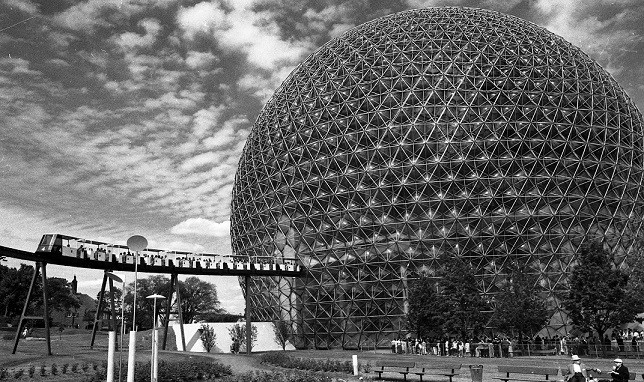
The United States pavilion
at the Expo 67 fair in Quebec.
Buckminster Fuller pioneered
the use of geodesic domes as
efficient structures covering
the greatest volume with the
optimum about of material
.
This overlapping of interests came from the zeitgeist of the 1960s. Inspired by the work of Buckminster Fuller, Ed  Bass and John Allen were influenced by the concept of 'design science exploration' which resists categorisation as either architecture or engineering and emphasizes the application of ingenuity over the marshaling of huge resources. Instead of regarding Biosphere 2 as a single experiment that could succeed or fail, it is more appropriate to understand it as a laboratory for multiple investigations. (2) The project could even fit within the definition of art, as chosen by Susan Sontag.

In her 1965 essay One culture and the new sensibility. Sontag wrote that the function of art was "giving pleasure and educating conscience and sensibility." Biosphere 2 may sit at the end of a spectrum of creations that might be considered art. The situation of its occupants was similar to that of the crew of a submarine as they lived with a fixed volume of air. Their personal effects had to be vetted as soap, shampoo, paint or glue that contained chemicals that could accumulate in the air were not allowed. This issue, along with many others raised by living in a microcosm, commented on life in the real world. Biosphere 2 blurred the distinction between science, engineering and performance art.

1. The Intensive Agriculture Biome in which the 'biospherian' crew produced their food.
2. The display screen on which data from 2000 sensors was displayed.
3. Although the ambition of Biosphere 2 was to emulate the process by which oxygen is replenished in the air by plants, it was necessary to use extensive electrical and mechanical systems to control temperate, create rainfall, control salinity of water bodies, remove algae from the 'rivers' and 'seas', as well as pumping water. The systems were monitored by engineers in
a nearby control centre, but maintained by the isolating crew.
4. The wilderness area was also maintained by the crew, pointing towards the 21st century when even non-cultivated areas may need to be helped to adapt to climate change.

The single greatest achievement of Biosphere 2 was to clarify the relationship between people and the actual biosphere. By attempting to live in a minuscule version of the entirety of Earth systems, the project highlighted problems that we face today. Population growth has changed the ratio of space that is occupied by humans, relative to wilderness, so as to approach that of biosphere 2.  We can no longer assume that waste is diluted by air and water to a level of insignificance. Human influence on Earth systems has increased to such a degree that we are now in a new geological era, the Anthropocene, 

Diamond mining. From the
first creation of ceramics
26,000 years ago, exploitation
of resources has expanded
to such an extent that
 humans can now be regarded
 as a geological force.
Within the limited definition of nature that excludes physics it is evident that economic activity is the main cause of species extinction. Within the wider definition of nature that includes physics; the change to the heat balance of the Earth caused by industrial carbon dioxide and methane
Open cast mine in Bohemia.
Humans move more material
around the Earth than glaciers
and rivers
emissions; and the discovery that humans move more material through mining, dredging and construction than the action of glaciers and rivers, means that 
humans are now a geological force on a planetary scale. During the first two 'missions' of biosphere 2 the crew had to manage every area of the space including the ocean, and the wilderness area. Their situation was similar to ours today.

The extent of environmental transformation and of global warming may require change not only to our modes of industry and agriculture but also the management of what used to be regarded as wilderness. Climate change may occur faster than plant species can migrate. The capacity to move bio-communities by transplanting species will be explored.(3) A more radical option would be to use CRISPR gene editing to adapt plants to new climates, or even increase the efficiency of photosynthesis so as to remove more carbon dioxide from the air. It is possible that we are already creating new species and driving evolution by changing environments. 

An arena will open up between the permaculture ideal of leaving as little trace on the Earth as possible and the technological ethos of genetic editing and geoengineering projects to mitigate climate change. Biosphere 2 presaged today's need for nuanced consideration of the interaction between artifice and nature - art that is not 'moral journalism'. In the 20th century a shared conception of landscape fragmented as nature disappeared into the laboratory and artists ended the distinction between content and style. The cultural baggage of landscape art; the sublime, the picturesque, numinist and symbolist imagery, was largely forgotten.  


TOP: Sub-atomic particles revealed in a bubble-chamber. The paths of the emerging particles are only partially constrained by the magnetic field within the walls of the chamber.

BOTTOM: Blue Poles by Jackson Pollock. His method of applying paint to a horizontal canvas on the floor of his studio created an 'all over' effect suggesting that the pictures are a small window on a greater field, seething with energy. Pollock's 'action' paintings often seem to resent the limiting borders of the canvas.

Since the Renaissance art and science have gradually drifted apart, with a few notable exceptions. For a few years in the period of impressionist painting it appeared that some artists' interests in the perception of colour overlapped with scientists' investigations of light. Some commentators have seen links between Einsteins theory of relativity and cubist art. Art came to concentrate more closely on subjective experiences as physics delved ever deeper into nature at the level of the sub-atomic. The divergence of art and science is illustrated by the Festival Pattern Group which was tasked with using images from x-ray crystallography to inspire work for the 1951 Festival of Britain exhibition. The studies that the group made resulted in designs they were used for craft and not art (as defined by contemporary art critics and galleries).

Jackson Pollock's belief that abstract expressionist painting resulted from a relationship between the creative process and fundamental aspects of nature relates to the title of Leo Szilard's paper "On the decrease of entropy in a thermodynamic system by the intervention of intelligent beings". His paintings suggest the emergence of significant forms created from energy. Photographs of sub-atomic particles and Pollock's painting suggest the limitless and therefore sublime aspect of nature.


1. Michael Heizer - Double NegativeMormon Mesa, northwest of Overton, Nevada in 1969-70.
2. Michael Heizer - displaced/replaced mass . Nevada. 1969
3. Michael Heizer - Circular Surface drawing - El Mirage Dry Lake, Mojave Desert, CA (ephemeral tracks created by motorcycle)
Land art constructions in the desert of the United States were a relisation of new directions in art that Susan Sontag described in her 1965 essay one culture and the new sensibility. Deliberately avoiding the emotional and cultural associations of landscape art, the constructions display a cool aloofness associated with conceptual art. Philosophers such as Hegel have argued that the beauty of ideas would eventually replace the need for visual art, but Land Art, while classifiable as conceptual art, escapes from this ideological cage by existing more as photographs and films/videos than pure ideas related by words. Pictures of land art constructions provide an aesthetic pleasure of their own, while the original creations continue to exist. Apart from ephemeral land art, the sites of these works can be regarded as both destinations for a pilgrimage and a touristic visitor attraction, like preserved Hollywood sets that become theme parks.


For art historians, the post-modern 'coolness' of the land art movement in the 1970s was full-stop to the genre of landscape art, but  it took place against a background of political turmoil. Robert Smithson produced his project Partially Buried Woodshed at Kent State University in January 1970. Later that year on the campus nine students were shot and four were killed by members of the National Guard during a Vietnam War protest. The emergence of the environmental movement from the Vietnam War protests was stimulated by the use of defoliant chemicals to deny cover for the Vietcong army. The dioxin by-product in the 'agent orange' sprayed by aircraft over huge areas left a toxic, carcinogenic and mutagenic legacy. 


1. Partially buried woodshed - An early land art experiment created at Kent State University by Robert Smithson January 1970.
2. Kent state University 4th May 1970. Four students were killed and nine students were wounded by the Ohio National Guard during a Vietnam War protest.
3. Aircraft spraying 'agent orange' defoliant in Vietnam. 

The unforeseen juxtaposition of Robert Smithson's partially buried woodshed and the shooting of thirteen students at Kent State University in the same year is a painful reminder that art does not operate in a vacuum, isolated from the society that ultimately funds it and provides an audience for it. The land art 'movement' of the 1970s was an implicit elision of landscape art that was associated with conservative values and privilege. Abstract art that occupied the attention of the art world between impressionism and the 1970s was influenced by the idea that aesthetic feelings for non-representational compositions arose from shared psychological processes, not dependent on race or class, that could contribute to 'universal' values that were implicitly socialist in nature. Before the Second World Was several abstract artists including Piet Mondrian and to a lesser extent Jackson Pollock took the idea of the psychological basis of creativity much further by involvement in the the quasi-religion Theosophy. Identifying the dividing line between mysticism and a poetic response to nature will remain a challenge for artists in the 21st century. 

In this century thermonuclear fusion could generate enough electricity to sequester carbon dioxide from the air. On a scale far greater than the defoliation of trees in Vietnam, the project would reverse global warming and allow us to release the gas at the onset of a future ice-age. Having a hand on the world's thermostat, we would be essentially 'flying the planet'. In the 21st century art cannot be limited to the rhetoric of protest movements. It could elucidate what we mean by the word 'nature' in a world shaped by synthetic biology and geoengineering.


1.Chloroplasts are the sites of photosynthesis in plants. They are controlled by genes that may be edited in the future so as to increase the removal of carbon dioxide from the atmosphere by 20%.
2Lancelot 'Capability' Brown  championed the practice of creating idealised landscapes within the estates of wealthy landowners. The modification of landscapes to match the ideal of romanticised landscape paintings was eventually extended to great public parks such as Central Park in New York. In the 21st century it may be considered necessary to modify what is currently regarded as natural bio-communities so as to adapt them to climate change and extract more carbon dioxide from the air.
3. In 1952 Stanley Miller created compounds associated with living organisms by passing an electric charge through a flask containing a mixture of gasses created to emulate the atmosphere of the Earth soon after its formation.     
4. After Stanley Miller's experiments created the basic building blocks of life it was briefly thought that life could be created in a 'second genesis' in the laboratory. This has proved to be beyond present capabilities, but radical modifications of existing cells with entirely synthesised genes has been accomplished. Although there is a large gap between Stanley Miller's creation of chemical precursors to life and the modification of existing cells, the cultural significance of the changing distinctions between naturally occurring systems and engineered systems will be a major subject for art in the 21st century. 


Climate engineering

The choices that are to be made in the 21st century around climate change and the Anthropocene are creating a need for an art of nature that moves on from the traditions of landscape art to respond to evolving values around artifice and naturalness. One challenge will be to remain distinct from both new-age mysticism and techno-utopianism. 


References from main text:

(1) Lovelock, James. Gaia : A New Look at Life on Earth. Oxford: Oxford UP, 1979. 

(2) Alling, Abigail., Mark. Nelson, and Sally. Silverstone. Life under Glass : The inside Story of Biosphere 2. Oracle, AZ: Biosphere, 1993


--------------------------------------------------------------------------------------------------------------