Showing posts with label Jackson Pollock. Show all posts

21 May 2021

Utopias - 9


On the 26th September 1991, a team of four men and four women, watched by international press and television reporters, sealed themselves into what was essentially a huge terrarium called Biosphere 2.  Built over three years at a site in Oracle, Arizona, the project was expected to demonstrate that a working scale-model of the Earth's biosphere could sustain a space colony with not just food but also air and water.  The air-tight environment was built on the scale of the Royal Botanic Gardens, Kew. To emulate the
Biosphere 2. The sealed environment was
divided into sections called 'biomes' and
can be regarded as a research facility to
test the viability of future self- supporting
space colonies and as a conceptual
art project foregrounding the complexity
of our biological and agricultural world.

entirety of the biological world the 1.27 hectare enclosure was covered by a glass and steel space-frame and divided into areas; rain-forest, ocean (with a coral reef), mangrove marsh, savanna, fog desert and an agricultural area. 

Biosphere 2 was the home for the volunteers for two years during which time they had to grow all their own food,  undertake a host of scientific measurements and (paradoxically) maintain the wilderness areas. The atmosphere was monitored every 15 minutes by 2000 sensors and the entire artificial environment was controlled by a computer and a nearby 'mission control'. Periods of rain were programmed and artificial waves created in the 'ocean'. Distinct climatic zones were emulated in different sections by heating, cooling, drying and humidifying the air.


The Bios 3 underground 
research facility in
Krasnoyarsk, Russia
Between 1972 and 1984 three 
people were able to live in
the 315 cubic metre
sealed environment with
25 % of oxygen supplied
by algae and wheat plants.
 The designers of Biosphere 2 attempted to encapsulate as many of the physical aspects of the Earth as possible. It was not the first experiment to use algae or plants to keep humans alive in a closed environment, but it was the first attempt at making a working model of the Earth's biosphere. In 1979 James Lovelock proposed that the totality of Earth systems form a self-regulating whole, which he named Gaia. (1) Although photosynthesising oxygen, Biosphere 2 could not  maintain temperatures as Earth systems do, and so the project used extensive underground air-management systems run by a gas-powered energy unit. 

Biosphere 2 was subsequently criticised for being unscientific because the 'biospherian' crew were not all qualified as scientists. This judgement ignored the fact that the first astronauts were test-pilots. The Skylab solar telescope was operated from 1973 to 1974 for hundreds of hours by astronauts who were not astronomers. It was also suggested that the project pursued a subjective 'new age' agenda. Some biospherians were from a performance background and they had previously worked with the designers of Biosphere 2, businessman and inventor Ed Bass and 'systems ecologist' John P. Allen, at a counter-cultural community known as the Synergia Ranch 
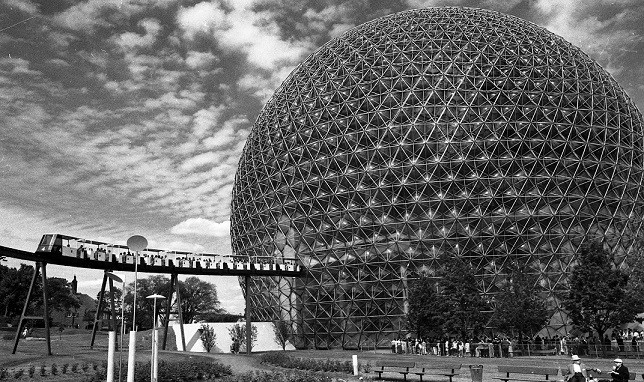

The United States pavilion
at the Expo 67 fair in Quebec.
Buckminster Fuller pioneered
the use of geodesic domes as
efficient structures covering
the greatest volume with the
optimum about of material
.
This overlapping of interests came from the zeitgeist of the 1960s. Inspired by the work of Buckminster Fuller, Ed  Bass and John Allen were influenced by the concept of 'design science exploration' which resists categorisation as either architecture or engineering and emphasizes the application of ingenuity over the marshaling of huge resources. Instead of regarding Biosphere 2 as a single experiment that could succeed or fail, it is more appropriate to understand it as a laboratory for multiple investigations. (2) The project could even fit within the definition of art, as chosen by Susan Sontag.

In her 1965 essay One culture and the new sensibility. Sontag wrote that the function of art was "giving pleasure and educating conscience and sensibility." Biosphere 2 may sit at the end of a spectrum of creations that might be considered art. The situation of its occupants was similar to that of the crew of a submarine as they lived with a fixed volume of air. Their personal effects had to be vetted as soap, shampoo, paint or glue that contained chemicals that could accumulate in the air were not allowed. This issue, along with many others raised by living in a microcosm, commented on life in the real world. Biosphere 2 blurred the distinction between science, engineering and performance art.

1. The Intensive Agriculture Biome in which the 'biospherian' crew produced their food.
2. The display screen on which data from 2000 sensors was displayed.
3. Although the ambition of Biosphere 2 was to emulate the process by which oxygen is replenished in the air by plants, it was necessary to use extensive electrical and mechanical systems to control temperate, create rainfall, control salinity of water bodies, remove algae from the 'rivers' and 'seas', as well as pumping water. The systems were monitored by engineers in
a nearby control centre, but maintained by the isolating crew.
4. The wilderness area was also maintained by the crew, pointing towards the 21st century when even non-cultivated areas may need to be helped to adapt to climate change.

The single greatest achievement of Biosphere 2 was to clarify the relationship between people and the actual biosphere. By attempting to live in a minuscule version of the entirety of Earth systems, the project highlighted problems that we face today. Population growth has changed the ratio of space that is occupied by humans, relative to wilderness, so as to approach that of biosphere 2.  We can no longer assume that waste is diluted by air and water to a level of insignificance. Human influence on Earth systems has increased to such a degree that we are now in a new geological era, the Anthropocene, 

Diamond mining. From the
first creation of ceramics
26,000 years ago, exploitation
of resources has expanded
to such an extent that
 humans can now be regarded
 as a geological force.
Within the limited definition of nature that excludes physics it is evident that economic activity is the main cause of species extinction. Within the wider definition of nature that includes physics; the change to the heat balance of the Earth caused by industrial carbon dioxide and methane
Open cast mine in Bohemia.
Humans move more material
around the Earth than glaciers
and rivers
emissions; and the discovery that humans move more material through mining, dredging and construction than the action of glaciers and rivers, means that 
humans are now a geological force on a planetary scale. During the first two 'missions' of biosphere 2 the crew had to manage every area of the space including the ocean, and the wilderness area. Their situation was similar to ours today.

The extent of environmental transformation and of global warming may require change not only to our modes of industry and agriculture but also the management of what used to be regarded as wilderness. Climate change may occur faster than plant species can migrate. The capacity to move bio-communities by transplanting species will be explored.(3) A more radical option would be to use CRISPR gene editing to adapt plants to new climates, or even increase the efficiency of photosynthesis so as to remove more carbon dioxide from the air. It is possible that we are already creating new species and driving evolution by changing environments. 

An arena will open up between the permaculture ideal of leaving as little trace on the Earth as possible and the technological ethos of genetic editing and geoengineering projects to mitigate climate change. Biosphere 2 presaged today's need for nuanced consideration of the interaction between artifice and nature - art that is not 'moral journalism'. In the 20th century a shared conception of landscape fragmented as nature disappeared into the laboratory and artists ended the distinction between content and style. The cultural baggage of landscape art; the sublime, the picturesque, numinist and symbolist imagery, was largely forgotten.  


TOP: Sub-atomic particles revealed in a bubble-chamber. The paths of the emerging particles are only partially constrained by the magnetic field within the walls of the chamber.

BOTTOM: Blue Poles by Jackson Pollock. His method of applying paint to a horizontal canvas on the floor of his studio created an 'all over' effect suggesting that the pictures are a small window on a greater field, seething with energy. Pollock's 'action' paintings often seem to resent the limiting borders of the canvas.

Since the Renaissance art and science have gradually drifted apart, with a few notable exceptions. For a few years in the period of impressionist painting it appeared that some artists' interests in the perception of colour overlapped with scientists' investigations of light. Some commentators have seen links between Einsteins theory of relativity and cubist art. Art came to concentrate more closely on subjective experiences as physics delved ever deeper into nature at the level of the sub-atomic. The divergence of art and science is illustrated by the Festival Pattern Group which was tasked with using images from x-ray crystallography to inspire work for the 1951 Festival of Britain exhibition. The studies that the group made resulted in designs they were used for craft and not art (as defined by contemporary art critics and galleries).

Jackson Pollock's belief that abstract expressionist painting resulted from a relationship between the creative process and fundamental aspects of nature relates to the title of Leo Szilard's paper "On the decrease of entropy in a thermodynamic system by the intervention of intelligent beings". His paintings suggest the emergence of significant forms created from energy. Photographs of sub-atomic particles and Pollock's painting suggest the limitless and therefore sublime aspect of nature.


1. Michael Heizer - Double NegativeMormon Mesa, northwest of Overton, Nevada in 1969-70.
2. Michael Heizer - displaced/replaced mass . Nevada. 1969
3. Michael Heizer - Circular Surface drawing - El Mirage Dry Lake, Mojave Desert, CA (ephemeral tracks created by motorcycle)
Land art constructions in the desert of the United States were a relisation of new directions in art that Susan Sontag described in her 1965 essay one culture and the new sensibility. Deliberately avoiding the emotional and cultural associations of landscape art, the constructions display a cool aloofness associated with conceptual art. Philosophers such as Hegel have argued that the beauty of ideas would eventually replace the need for visual art, but Land Art, while classifiable as conceptual art, escapes from this ideological cage by existing more as photographs and films/videos than pure ideas related by words. Pictures of land art constructions provide an aesthetic pleasure of their own, while the original creations continue to exist. Apart from ephemeral land art, the sites of these works can be regarded as both destinations for a pilgrimage and a touristic visitor attraction, like preserved Hollywood sets that become theme parks.


For art historians, the post-modern 'coolness' of the land art movement in the 1970s was full-stop to the genre of landscape art, but  it took place against a background of political turmoil. Robert Smithson produced his project Partially Buried Woodshed at Kent State University in January 1970. Later that year on the campus nine students were shot and four were killed by members of the National Guard during a Vietnam War protest. The emergence of the environmental movement from the Vietnam War protests was stimulated by the use of defoliant chemicals to deny cover for the Vietcong army. The dioxin by-product in the 'agent orange' sprayed by aircraft over huge areas left a toxic, carcinogenic and mutagenic legacy. 


1. Partially buried woodshed - An early land art experiment created at Kent State University by Robert Smithson January 1970.
2. Kent state University 4th May 1970. Four students were killed and nine students were wounded by the Ohio National Guard during a Vietnam War protest.
3. Aircraft spraying 'agent orange' defoliant in Vietnam. 

The unforeseen juxtaposition of Robert Smithson's partially buried woodshed and the shooting of thirteen students at Kent State University in the same year is a painful reminder that art does not operate in a vacuum, isolated from the society that ultimately funds it and provides an audience for it. The land art 'movement' of the 1970s was an implicit elision of landscape art that was associated with conservative values and privilege. Abstract art that occupied the attention of the art world between impressionism and the 1970s was influenced by the idea that aesthetic feelings for non-representational compositions arose from shared psychological processes, not dependent on race or class, that could contribute to 'universal' values that were implicitly socialist in nature. Before the Second World Was several abstract artists including Piet Mondrian and to a lesser extent Jackson Pollock took the idea of the psychological basis of creativity much further by involvement in the the quasi-religion Theosophy. Identifying the dividing line between mysticism and a poetic response to nature will remain a challenge for artists in the 21st century. 

In this century thermonuclear fusion could generate enough electricity to sequester carbon dioxide from the air. On a scale far greater than the defoliation of trees in Vietnam, the project would reverse global warming and allow us to release the gas at the onset of a future ice-age. Having a hand on the world's thermostat, we would be essentially 'flying the planet'. In the 21st century art cannot be limited to the rhetoric of protest movements. It could elucidate what we mean by the word 'nature' in a world shaped by synthetic biology and geoengineering.


1.Chloroplasts are the sites of photosynthesis in plants. They are controlled by genes that may be edited in the future so as to increase the removal of carbon dioxide from the atmosphere by 20%.
2Lancelot 'Capability' Brown  championed the practice of creating idealised landscapes within the estates of wealthy landowners. The modification of landscapes to match the ideal of romanticised landscape paintings was eventually extended to great public parks such as Central Park in New York. In the 21st century it may be considered necessary to modify what is currently regarded as natural bio-communities so as to adapt them to climate change and extract more carbon dioxide from the air.
3. In 1952 Stanley Miller created compounds associated with living organisms by passing an electric charge through a flask containing a mixture of gasses created to emulate the atmosphere of the Earth soon after its formation.     
4. After Stanley Miller's experiments created the basic building blocks of life it was briefly thought that life could be created in a 'second genesis' in the laboratory. This has proved to be beyond present capabilities, but radical modifications of existing cells with entirely synthesised genes has been accomplished. Although there is a large gap between Stanley Miller's creation of chemical precursors to life and the modification of existing cells, the cultural significance of the changing distinctions between naturally occurring systems and engineered systems will be a major subject for art in the 21st century. 


Climate engineering

The choices that are to be made in the 21st century around climate change and the Anthropocene are creating a need for an art of nature that moves on from the traditions of landscape art to respond to evolving values around artifice and naturalness. One challenge will be to remain distinct from both new-age mysticism and techno-utopianism. 


References from main text:

(1) Lovelock, James. Gaia : A New Look at Life on Earth. Oxford: Oxford UP, 1979. 

(2) Alling, Abigail., Mark. Nelson, and Sally. Silverstone. Life under Glass : The inside Story of Biosphere 2. Oracle, AZ: Biosphere, 1993


--------------------------------------------------------------------------------------------------------------


04 August 2020

Utopias - 8 Artifice and nature


Utopias - 8 on Blurb

On Saturday 17th March 2001 two British newspapers, The Guardian and The Independent carried two different but equally remarkable photographs on their front pages. Over the Guardian headline " The news from Ground Zero: foot and mouth is
winning." a photograph of dead cattle on a pyre presents an almost apocalyptic vision of the efforts to cull and dispose of cattle that were either diseased or at risk of infection from the foot and mouth virus. The dead animals are piled upside down and their burnt hides seen in the compressed telephoto perspective would resemble a volcanic landscape if it were not for protruding legs and hooves silhouetted against smoke, coloured orange by the glowing fire. Tongues of flame curl upwards between the blackened carcasses.


The Independent newspaper also had a front page story about the foot and mouth epidemic  but above the headline there is a photograph of the newly opened Eden Project education centre and 'eco-park'. Situated in a former open-cast china clay pit at Bodelva near St Austell in Cornwall, eight geodesic domes  are visible nestled in the transformed industrial site. The photo-caption calls the project a 'Man-made Eden' and the expectant image contrasts with the gloom of the foot and mouth epidemic.

Although highly infectious, the FMD virus does not kill most of the cattle it infects but it does inflict painful sores, reduced weight and milk yield, as if to sabotage the work of farmers. The modern long-distance transportation of animals helps the disease to spread. Coming after the BSE crisis, caused by feeding animal protein to herbivorous cattle, the two farming emergencies suggest transgression on the part of humans, like 'The Fall' reputed to have occurred in the legendary Garden of Eden. 


The two photographs are very different from the vision of nature and agriculture in the tradition of landscape art. The piles of incinerated animals suggest a breach of an implicit contract between humans and nature. (1) The aesthetics of landscape art often suggested a relationship between farmers and the providence of the natural world. In the Independent photograph of the Eden Project the site looks like a futuristic moon-base translocated to a misty Cornish landscape. Inside the domes, that conform to the undulating ground like bubbles, flora from all of the world thrive. The Eden Project addresses the separation of consumers from nature and displays it in a global context, which was never within the scope of landscape artists who only ever depicted localised views, whether picturesque or sublime.

The artist Robert Smithson wanted to use industrially disrupted landscapes, like the china clay pit at Bodelva, to make site-specific projects. Although originally called Earth Art, early Land Art was not synonymous with ecology. Smithson tried to create art without cultural precedent, but Land Art was part of a 20th century ambition of artists to supersede views of nature. . When Piet Modrian wrote "by means of abstraction art has interiorized form and colour" (2) he implied that art should no longer be constrained by nature. 


In the 1950s Jackson Pollock made this idea explicit when he created abstract paintings that he believed to be expressions of psychological states.  By placing canvases on his studio floor Pollock adopted a paint-dripping technique, producing an 'all over' effect that resembles the contemporary photographs of the paths of sub-atomic particles in bubble-chamber experiments.


 Other artists made abstract paintings on a scale that could barely fit in a gallery. In the 1970s Land Art continued this development by leaving the gallery altogether and used the landscape itself as a medium for sculpture. Smithson's early experiments in Land Art were 'non-sites' that twinned a chosen remote location with a gallery exhibiting photographs, drawings and samples of material from the site. 

Michael Heizer’s 
Circular Surface, 
Planar DIsplacement 
Drawing in 
El Mirage Dry Lake.
Starting with small interventions in the landscape (incisions, pouringof tar and inserting poles) Michael Heizer, Robert Smithson andWalter De Maria went on to make varied projects that were united by an insistent bravura that challenged the process by which art objects are legitimised, the art gallery and the collector. These constructions, excavations and installations were made at desert locations so remote that, realisticaly, the main audience for these pieces would only ever see them in photographs. The photographic documentation of the constructions became an integral part of the artwork, one of the features of conceptual art from which Land Art emerged and supposedly set it apart from the landscaping of aristocrat's estates in 18th century Europe.

The relationship between the designs of country estates and their depiction in paintings as well as the broader genre of landscape art is comparable to that of 20th century Land Art and photography. As land artists saw each others art-making through photographs, so landscaped gardens and landscape paintings enjoyed a circular exchange of influences. Aristocrat's estates and landscape painting were a tangible or visible form of the idea of virtue, the quality of order and a feeling of purpose behind nature. Landscape art turned the natural world  into a persuasive idea of 'nature' that evoked feelings of wonder when it was picturesque and awe when it was sublime.


'Capability' Brown's
design for an improved
landscape
By using their wealth to fabricate actual landscapes based on the aesthetics of landscape pictures aristocrats associated their own social position with the concept of natural order. By owning landscape paintings the middle class could buy into this vision and state their place on the social ladder. In the industrial age primary wealth moved away from the landed gentry and in the 20th century became concentrated in corporations. Land Art was a reaction against the cultural heritage of landscape art as the Vietnam War escalated, civil rights protests grew and NASA explored the airless deserts of the moon.

Although still dependent on wealthy individuals such as Robert Scull and Virginia Dwan, Land Art gave young artists a place to experiment with conceptual art, unaccountable to national art institutions and the 'military industrial complex'. In the context of social turmoil in the 1960s the deserts of the western United States promised a 'tabula rasa' in which a new ethos could be explored. From 1969-1970 Michael Heizer used a bulldozer to excavate two parallel cuts in the side of Mormon Mesa near Overton in Nevada to make Double Negative. 240,000 tons of rock was moved to make the converging channels, parallel to the valley side, extended towards each other by ramps formed from excavated spoil.

Unlike 18th century country estates, the Land Art projects display an absurdist aspect. In 1970, Robert Smithson's Spiral Jetty parodied the sense of purpose inherent in an actual jetty. 6,650 tons of rock were dumped into Salt Lake, Utah to form a line that spirals in on itself. Heizer's and Smithson's projects look like relics from lost civilizations. Walter De Maria's 1977 Lightning Field (a grid of vertical poles in an oblong one mile by one kilometre) looks like a survey for a vast building. These projects are concepts, like Gustav Holst's The Planets which explores themes of beauty, grandeur and the sublime, while omitting the Earth from the symphony.

Whereas Land Art took art from the gallery, in 1991 the Biosphere 2 project tried to emulate the world in a sealed environment. Eventually it failed to make enough oxygen for its human 'crew'. (3) The designers of Biosphere 2 struggled with the complexity of biological nature, like the hapless creators of the 1930s Oklahoma dust-bowls. Through places like Biosphere 2 and the Eden Project we learn that we are reliant on the biosphere in ways we may not always fully understand.. To reflect our new place in nature, art has to create a visual equivalent to the poetry of Kathleen Jamie, who fluently combines the cosmic and the geological with the personal.


The first experiments with land art took place against a background of unprecedented rate of social change and significant political turmoil. Robert Smithson produced his early project partially buried woodshed at Kent State university in January 1970. By a tragic co-incidence in the summer of that year nine students were shot and four were killed on the campus, by members of the National Guard, during a Vietnam War protest. While the art world, at the level of major institutions and collectors, remained aloof from the social conflicts and the exigencies of those caught up in them it had its own internal battles to fight. What was referred to in the 1930s as "the crisis of figuration" (abstraction) in art came to a head with the rise to fame of Jackson Pollock. By 1949 Life magazine was asking " Is he the greatest living painter in the United States?" 

From a 21st century post-modern perspective the controversy surrounding Pollock may seem trivial, but when he completed his Number 31 painting in 1950 he asked his wife Lee Krasner "Is this even a painting?" Being at the centre of the 'culture war' between the Avant- Garde and the conservative ideal of art may have accelerated Pollock's mental and physical destruction. Perhaps art did not end Pollock's life, but like individuals who carry a desperation within them that causes them to seek out civil wars and to volunteer to fight for one side, he was drawn to the cause.

 Although once at odds with a conservative ideal of art, most of the abstract expressionist artists have now been absorbed by the corporate world and their pictures have sold for tens or hundreds of millions of dollars. It is not possible to look at the photographs of the Degenerate Art exhibition organised by the Nazi party in 1937, so at to mock the products of the avant-garde, and not imagine the pictures gracing the walls of millionaires today. The Hollywood dramatisation of the life of Vincent van Goch Lust for Life marks the time when the idea of the 'tortured artistic genius' became lodged within the public imagination. The film was released in 1956, the same year as Jackson Pollock's early death in a road accident. It is this association of the avant-garde with the unique collectability of the work of exceptional individuals that commends it to the commercial world, and the investment portfolios of the wealthy. 

Artists have never changed the world as much as the ant-Vietnam War movement. The protests created a mass awareness of environmental issues that inform the politics of today. The exact point of contact between the two protest movements could be defined by the use of defoliant chemicals in Vietnam. The tactic of denying cover for the Vietcong army left a toxic, carcinogenic and mutogenic legacy caused by the dioxin by-product in the 'agent orange' sprayed by aircraft over huge areas to remove leaves from trees in zones of infiltration. 

In the midst of the turmoil of the last century landscape art became marginalised and its aesthetics associated with reactionary elites. In the 1960s landscape art became as irrelevant to a new socially engaged art as it was to the 'high end' art sought after by the wealthy collectors. In the 21st century we have come full circle. An engagement with landscape and the wider awareness of the environment and Earth systems is the most important challenge for art. This circularity of change mirrors the change in the appearance of science in society. In the 20th century science became associated with nuclear weapons and industrial pollution. In the 21st century it is the turn of right-wing politicians to deny the evidence of climate change provided by science. 

The moon-race was another kind of proxy-war between the U.S.A. and the U.S.S.R. The objective of the race, the airless and lifeless surface of the moon seemed to personify what was wrong with science for many people.  The 1966 Daily Mail headline " The picture of the century" over the Lunar Orbiter oblique photograph of the crater Copernicus on the moon could not have been more wrong.  It is either the Apollo 8 Earthrise picture or the Apollo 17 Blue Marble picture of the Earth that captured the imagination of the world.


  1. Apollo 8 - 24th December 1968  Earthrise                       Apollo 17 - 7th December 1972 Blue Marble


In the melee of competing aspirations in 20th century art, landscape all but disappeared. Traditional landscape paintings became deeply unfashionable, the cubist, surreal and abstract expressionist movements became collectable and out of the anti-war, CND and feminist movements a socially committed idea of public art evolved that concentrates of the idea of individual fulfillment and identity. In the 21st century the challenge is to produce forms of art that encourage contemplation of artifice and nature as well as choices around genetic editing and geoengineering that must be made in the Anthropocene, without falling into the trap of being only protests.
Utopias-8 on BLURB

22 March 2019

Utopias 7


On the 25th December 1758 the return of a comet, predicted by
Halley's Comet photographed in 1910
Edmond Halley 53 years earlier, was seen in Germany. News of the arrival was greeted with jubilation in scientific circles around the 
world
and especially in France where a group of mathematicians had calculated a delay of 618 days, caused by the
gravitational influence of Jupiter. The discovery proved the ability of science not only to describe nature but also to predict the future behaviour of physical systems. If the motion of celestial mechanics could be predicted then the workings of unbuilt machines would also. The industrial revolution would no longer progress by trial and error but would use science to explore nature and the power of steam, electricity and the atom. 


The Plutonium bomb ready
for detonation in July 1945
The test was required as
the 'prompt criticality'
method of detonation was 
less certain than the 'gun-type'
Hiroshima weapon.
Science came to dominate medicine, industry, transport, communication  and warfare. In 1945 when two atomic bombs were detonated in Japan the uranium bomb used to attack Hiroshima had not been tested, such was the confidence of its designers. A test of a plutonium weapon in the United States was deemed necessary three weeks before the attack on Nagasaki. Edmond Haylley knew that 'his' comet would not return in his lifetime. Before the first atomic explosion in July 1945 Hans Bethe calculated that it would not ignite the entire atmosphere of the Earth.


The pursuit of knowledge that had been the essence of the

Enlightenment took a dark turn in 1945 and art had little to reflect this. Although  film, television, literature and journalism were greatly exercised by the atomic age, suggestions of apprehension hinted at in Joseph Wright's 18th century paintings of scientific
Sphere Within Sphere 
Arnaldo Pmodoro
experiments found no expression, in the art of the 20th century, that was equal to the scale of change.                                  


The desire to elicit power from nature motivated the creation of prehistoric cave paintings and was explored by philosophers in classical Greece, but the adjustment from belief in magic to testable theories of nature as physical forces is still not complete. 'Nature' now has layered meanings, one of which has the physical laws of nature operating only in the background to the life and immediate experience of individuals. This idea of nature has evolved  to exclude the seemingly abstruse discoveries of science. It has become a habit of mind that science and the phenomena it describes are distinct from life. The use of atomic bombs reinforced this tendency by associating science with mass destruction. Conflating the misgivings associated with the atomic bombing of cities with the uncanny conversion of matter to energy, a part of popular culture derived a sense of science as being a transgression of nature .  (1)

 Thermonuclear weapons tested from 1952 onwards are one thousand times more powerful than the atomic bombs that ended the Second World War. Convection currents from the explosions were so strong they thrust radioactive material into the stratosphere and around the world. By the 1960s even the bones 
of penguins in Antarctica contained detectable amounts of strontium-90. Other radioactive products are now being incorporated into newly-forming rocks. Such a radioactive marker, as well as chemical changes caused by climate change, are cited as a 'golden spike' recording an idetifiable start to the Anthropocene geological era in which humans are the dominant influence on Earth systems. 


As well as global warming, caused by reducing the infra-red transparency of the atmosphere
From Mars and its Canals 
this drawing by Percival 
Lowell is the result of an 
optical illusion. Over years
of telescopic observations
Lowell produced numerous
drawings of 'canals' but the
features have never been 
photographed.Through his 
books Lowell introduced 
the idea of global scale 
engineering to the popular
imagination.
through carbon dioxide and methane emissions, industrial activity now moves as much material as rivers and glaciers. Humans are now a planetary force on a scale imagined by Percival Lowell in his erroneous but influential books about a supposed civilization creating a huge network of irrigation canals on Mars
Our technosphere, the total quantity of material made or relocated by humans, has been estimated to weigh 30 trillion tons. It takes 20 tons of rock to produce a single gold wedding ring.

In his book the American Technological Sublime David Nye claims that between the start of the 'atomic age' in 1945 and the launch of Apollo 11 in 1969 the  impression of  awe once associated with nature, in art and literature, also became attached to technology. However the technological sublime is not part of contemporary art. The transformation of the Earth is more likely to be depicted through the ability of film and video editing to join places and the capacity of aerial photography to convey a landscape undiminished by distance. 


Proliferation of mass media at the start of the 20th century coincided with the abandonment of perspectival representation of three dimensional space by avant garde art, leaving photography to continue the aesthetic of the sublime. Ansel Adams' photographs of the pristine Sierra Nevada were contemporary with Le Corbusier's photographic book celebrating the cultural importance of aircraft. (2) In the 20th century the National Geographic magazine brought these aesthetics to a mass readership in articles and photographs that tacitly assumed an age of agricultural and industrial improvement would continue unabated with the natural world remaining essentially unchanged in the background, like the painted scenic panels in classical Greek theatre that were the origin of landscape art. 


In the tradition of 'sublime' landscape painters such as Albert Bierstandt and Thomas Moran National Geographic developed a style of landscape photography dependent on attaining an ideal viewpoint. The getting of the photograph became part of the story. The Earthrise picture taken by the Apollo 8 astronauts in lunar orbit
on the 24th December 1968 is perhaps the ultimate landscape photograph. The image of the Earth rising over a lifeless Moon is uncanny, revealing the entirety of our planet while conceding nothing of our lived experience of it. Earthrise is beguiling image with a beauty that is hard to define, like a successful abstract picture. 
The Apollo 8 Earthrise  photograph taken on 

24th December 1968.

In the 1950s when Jackson Pollock made his abstract paintings it appeared that art had never been further apart from science but his technique of dripping paint onto canvas prefigured a type of sculpture shaped by material determinants  - gravity, tension, elasticity - like the formation of actual landscapes. In 1968 Robert Smithson proposed 'non-site' exhibitions that emulated science museums by displaying rocks from a remote site in a gallery, with accompanying maps and photographs. In the 1970s process-driven sculpture combined with the concept of non-sites and Michael Foucalt's 'heterotopias' to evolve a art-form known as 'Earthworks'. (3)

Paradoxically Jackson Pollock's dramatic abstract paintings seem to look towards a future dominated by science and also look backwards to ancient times that had mystical beliefs lost  to the rational secular society of 1950s America. Pollock stated in a radio interview that" the modern painter cannot express this age, the airplane, the atom bomb, in the old forms of the Renaissance or any other past culture.” Superficially his most energetic paintings resemble the swirling patters seen in contemporary bubble chambers that revealed the tracks of sub-atomic particles, but he was influenced by native American sand painters, Jungian Psychology, Theosophy and a general feeling articulated by Laurens Van De Post in his book The Lost World of the Kalahari that the 'civilized' world had lost a connection with nature.


Bubble chamber photographs made in the 1950s.


Virginia Dwan purchased a site on the shore of 


Great Salt Lake (Utah) enabling Smithson to built his Spiral Jetty in 1970 using 1400 tons of rock to create a spiral causeway. This iconic construction is part of the canon of Earthworks, paid for by Dwan and later known as Land Art; including Michael Heizer's Double Negative (two trenches bulldozed across a valley) and a precursor to Walter De Maria's Lightning Field (an array of metal poles in a grid pattern). Land Art related to the engineered landscapes of the 1960s. In the 21st century the brute force of diesel-powered excavation is joined by the more subtle and far-reaching ability to edit genes. Photosynthesis might be re-edited In the future so that plants could take more carbon dioxide from the air. Plants or ecosystems could be 'pre-evolved' to survive climate change but their behaviour would not be as predictable as the movement of comets.

(1) Unfinished, Untitled or Not Yet, 1966 by Eva Hesse  Nine dyed net bags, clear polyethylene sheeting, metal weights and string. Eva Hesse was influenced by Jackson Pollock, speaking about a different piece she said " This piece is very ordered. Maybe I'll make it more structured, maybe I'll leave it changeable. When it's completed, its order could be chaos. Chaos can be structured as non-chaos. That we know from Jackson Pollock." 

(2)  Quartered Meteor 1969 by Lynda Benglis follows on from the anti-form process-art that allowed the shape of an artwork to be decided by the physical laws of nature, such as gravity and viscosity. Quartered Meteor was originally made by pouring polyurethane into the corner of a gallery. Later the ephemeral form was cast in lead resulting in a sculpture that resembles cooled lava. The anti-form 'movement' was distinct from abstract forms such as Henri Moore or Barbara Hepworth's sculptures as they determined the final form of their work from their imagination whereas process sculpture was ultimately decided by nature after the artist set up the initial starting conditions of the 'experiment'. 

(3) Texas Overflow - Robert Smithson wanted to make "artificial landscapes without cultural precedent". In 1966 Smithson became the artist-consultant to a firm of architects and engineers competing for he Dallas-Fort Worth Airport project. His brief was to design artworks to occupy the unused areas of land between runways and taxi-ways. Out of necessity they had to be flat. Although unrealised his drawings represented a break from the history of landscape design. Whereas the Paradeisos of the Middle-East and the landscape gardens of European aristocrats implied a purposeful origin to nature and expressed a divinely creative process at work in landscapes the disregarded voids between concrete runways signify nothing. These industrial Tabla Rasa presented Smithson with a blank 'canvas' on which to explore his ambition.

After settling in New York in 1960 Robert Smithson began to socialise with artists such as Michael Heizer and Nancy Holt (who he married in 1963). Smithson became interested in extending Eva Hess's idea of allowing sculptures to find their eventual form, through flow of material, to large scale structures in the landscape. 

From a young age Smithson was interested in dinosaurs and natural history and he combined an interest in geological processes with the emerging Land Art movement. One of his most innovative ideas involved pumping asphalt into a disused limestone pit. The idea of creating a kind of artificial lava field by pumping the liquid in to the centre of the landscape feature and allowing it to flow outwards and solidify is a development of the gallery-based process-art, re-located in the landscape. By allowing physics to determine the final form of process-art it re-connects with nature in a way the traditional landscape art never did. Texas Overflow was realised in a reduced form when Smithson organised a truck-load of asphalt to be tipped into a pit near Rome .

(4) Artists such as Eva Hesse in the 1960s concentrated the attention of the art world on the possibilities offered by new materials. In the previous decade Jackson Pollock occasionally included 'foreign matter' such as cigarette butts and broken glass in his still-wet paintings. Whereas Pollock was probably influenced by alcohol consumption during these particular painting sessions, Eva Hess explored the deliberate use of industrial materials. Her Contingent 1969 piece consisted of cheesecloth set in latex and fiberglass.  Achieving the cover of Artforum magazine, Contingent identifies firmly with the Anthropocene era as does much of Hesse's artwork which consisted of "large expanses or dense coagulations and snarls of matter - of latex, of fibreglass, of cord, of plastic" (4) Robert Smithson took this idea of the expressive quality of matter and applied it on a landscape scale when he built Spiral Jetty in 1970.

Land Art constructions are not necessarily the same as Environmental Art. The 'classic' constructions such as Spiral Jetty were not concerned with modern environmental issues and indeed celebrated our power over nature to some extent. The Palm Islands development  is a commercialised legacy of Spiral Jetty.

In 1990 the Galileo spacecraft flew by the Earth for a gravitational slingshot to accelerate it onward to Jupiter. Carl Sagan recognised the opportunity to see if intelligent life could be detected from space. Although cultivated land was visible in Australia only a broadcast radio signal was deemed to be an unambiguous sign of life. Now contemporary art should feel this similarly ambiguous age of landscape, nature and artifice.


The Challenger space shuttle explosion resulted in the loss of the spacecraft and crew. A subsequent safety review allowed the space shuttle to return to service but it was decided that launching Galileo from the shuttle with a liquid fueled rocket in the cargo bay would be too dangerous. The solution to the problem was to switch the launch an alternative rocket that would not be powerful enough to sent the spacecraft on a simple trajectory to Jupiter but would require a gravitational slingshot flyby of Venus and two from Earth. Carl Sagan realised that the two flybys of Earth would present the opportunity to see what an exoplanet would look like to a probe sent from Earth. Pretending that they had no knowledge of the Earth, experts examined pictures from Galileo as if they were seeing our planet for the first time but were unable to gleen any conclusive photographic evidence of the changes made by humans. In this 'expedition to Earth' only a narrow-band radio signal from an unidentified radio station detected by an antenna on the spacecraft gave an unambiguous indication of technology.  

(1)  From an altitude of about 500,000 kilometers most of
Egypt  and the Arabian Peninsula were photographed on December 9, 1992

(2) The
Simpson Desert in Australia seen from 56,000 kilometer at about 2:30 p.m. PST, Dec. 8, 1990 

(3) 
Antarctica 

(4) Apart from the 'expedition to Earth' experiment two sets of laser pulses were transmitted to Galileo over a distance of 1.4 million kilometers (870,000 miles) in a communications experiment seen in this long-exposure image made by the spacecraft's imaging system. To register the laser light as points it was necessary to allow the rest of the Earth to become blurred. The image could serve as a metaphor for the Anthropocene in which our artificial world of technology and nature will increasingly compete for our attention in a future where the the artificial and the natural become indistinct.

References

(1) Sontag, S. (1966). The imagination of disaster. In: Against interpretation, and other essays: / Farrar,Strauss & Giroux. New York.

(2)  Le Corbusier (1935) Aircraft: The New Vision / The Studio. London, New York.

(3) Kastner, J. (2005). Land and environmental art / edited by Jeffrey Kastner ; survey by Brian Wallis. London.


(4) Rosalind Krauss in - Hesse, E., Serota, N., Whitechapel Art Gallery, Rijksmuseum Kröller-Müller, & Kestner-Gesellschaft. (1979). Eva Hesse, 1936-1970 : Sculpture / [edited by Nicholas Serota]. London

Twitter


"...every universe is concentrated in a nucleus, a spore, a dynamized center. And this centre is powerful, because it is an imagined center. One step further into the world of images offered us by Pieyre de Mandiargues, and we see the center that imagines; then we can read the landscape in the glass nucleus. We no longer look at it while looking through it. This nucleizing nucleus is a world in itself. The miniature deploys to the dimensions of a universe. Once more, large is contained in small.”


Gaston Bachelard - Miniature - The Poetics of Space